Crypto Taxation for Freelancers and Remote Workers: Your Guide to Staying Compliant
 Michael Yang
5 min read
Michael Yang
5 min read
Let’s be honest. As a freelancer or remote worker, you already juggle a dozen hats—from project manager to your own IT department. Now, add “crypto tax specialist” to the list? It sounds daunting. The world of digital assets is thrilling, offering new ways to get paid and invest, but it comes with a tangled web of tax implications that can trip up even the savviest independent professional.
Here’s the deal: tax authorities worldwide are no longer looking the other way. They’re actively chasing clarity—and revenue—from cryptocurrency transactions. For you, this isn’t just about trading; it’s about income, expenses, and a global, borderless financial tool. Let’s dive into what you absolutely need to know.
When Crypto Isn’t Just an Investment: It’s Your Income
For most employees, crypto is a speculative asset. For you? It can be your livelihood. This shifts the entire tax landscape. The core principle is this: receiving cryptocurrency as payment for services is treated as ordinary income. It’s that simple, and that complex.
Imagine you’re a developer and a client pays you 0.5 ETH for a project. On the day you receive it, you must record the fair market value of that ETH in your local currency (USD, EUR, etc.). That amount—let’s say $1,500—is taxable income, just as if they’d paid you in cash. It goes straight onto your Schedule C (or your country’s equivalent) as gross income.
The tricky part? Crypto’s wild volatility. You received $1,500 worth of income… but by the time you convert it to fiat, its value might have swung dramatically. That leads us to the next layer: capital gains.
The Double-Event Tax Trigger: Income Event + Disposal Event
This is the crucial concept many miss. With crypto, you can get taxed twice on the same asset. Not double taxation, exactly, but two separate events.
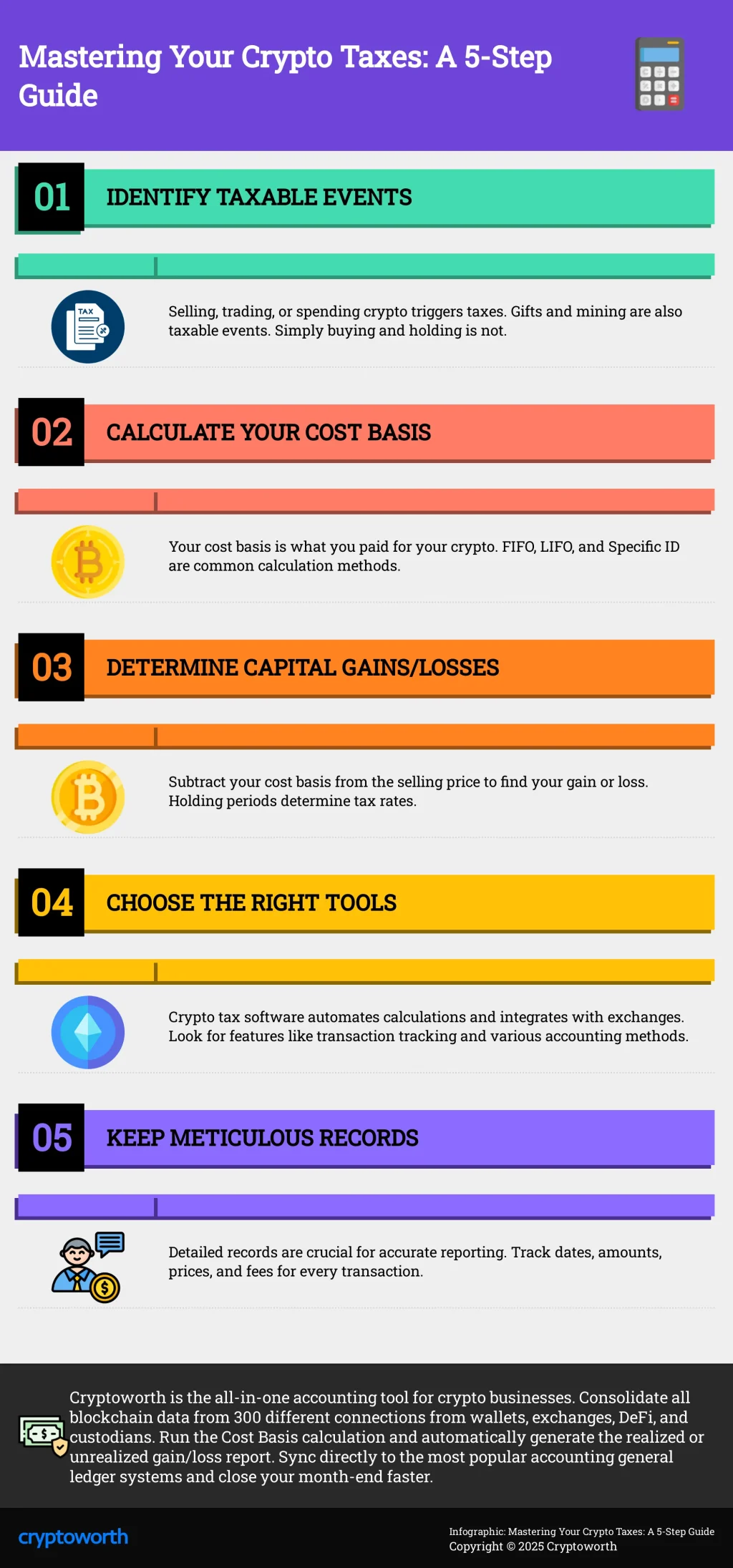
- Event 1: The Income Tax Hit. When you get paid in crypto, you owe income tax (plus self-employment tax in the U.S.) on its value at that moment.
- Event 2: The Capital Gains Tax Hit. Later, when you sell, trade, or use that crypto, you trigger a capital gain or loss. Your “cost basis” is the value you declared as income. If you sell it for more, you pay capital gains tax on the profit. If you sell for less, you can claim a loss.
So, using that 0.5 ETH example: you declared $1,500 income. If you hold it and later sell it when it’s worth $2,000, you have a $500 capital gain. If you panic-sell during a dip at $1,200, you have a $300 capital loss. Tracking these basis numbers is non-negotiable.
Everyday Crypto Actions That Are Taxable Events
It’s not just selling for cash. In fact, many freelancers stumble here. These common actions typically trigger a capital gains event:
- Swapping one token for another (e.g., ETH for USDC).
- Using crypto to buy a good or service (a laptop, a course).
- Receiving staking rewards or DeFi yield (this is often treated as additional income at receipt, then a capital gain later).
- Getting paid in a stablecoin? Yep. It’s still crypto, and its value is pegged, but the income recognition rule applies.
The Remote Worker’s Cross-Border Conundrum
This is where it gets really interesting. You live in Portugal, your client is in Canada, and they pay you in Bitcoin. Which country’s tax rules apply? Honestly, this is a gray area still hardening into law.
Generally, you are taxed on your worldwide income by your country of tax residence. But you must also consider the source of the income. Some countries have tax treaties to prevent double taxation, but crypto often isn’t explicitly addressed yet. The safest bet? Report the income where you live and work. But if you’re a digital nomad, you absolutely must seek localized advice—your tax home status is everything.
Can You Deduct Crypto Expenses?
Sure! If you use crypto to pay for business expenses, you can potentially deduct them. But remember the two-event rule. Say you use some of your income-ETH to pay for web hosting:
- You dispose of the ETH, calculating a capital gain/loss based on its current value vs. your cost basis (the income value you recorded).
- The market value of the ETH at the time of the transaction becomes your business expense deduction amount.
It’s administratively heavy, which is why many freelancers simply convert to fiat first and pay expenses traditionally. It’s cleaner, you know?
Practical Steps to Keep Your Sanity (and Compliance)
You can’t wing this. The paper trail is your best friend. Here’s a straightforward system:
| What to Track | Why It Matters | Tool/Method |
|---|---|---|
| Date & Time of Every Transaction | To establish fair market value at that exact moment. | Exchange records, blockchain explorer. |
| Value in Local Currency at That Moment | For income reporting and cost basis calculation. | Historical price APIs, crypto tax software. |
| Purpose of Transaction | Was it payment for service? A trade? A purchase? | Manual log or software tags. |
| Wallet Addresses (Sender/Receiver) | For audit trail and proving ownership/activity. | Just keep them in a secure log. |
Invest in a dedicated crypto tax software. These tools connect to your wallets and exchanges, auto-fetch transactions, and calculate your gains, losses, and income. They’re worth their weight in… well, Bitcoin. They handle the brutal calculations so you don’t have to.
Looking Ahead: The Changing Tide
Regulations are evolving fast. We’re seeing more clarity on staking, NFTs as income, and even the treatment of decentralized autonomous organizations (DAOs). For the freelancer, the trend is toward more reporting, not less. Exchanges are increasingly issuing 1099s (or their equivalents), and tax authorities are deploying chain analysis tools.
That said, this isn’t a reason to avoid crypto. It’s a reason to respect it as the serious financial instrument it is. Integrating it thoughtfully into your freelance business can be powerful—offering speed, lower fees, and access to a global client pool. But the foundation must be built on compliance.
In the end, navigating crypto taxes is about embracing the complexity, not fearing it. It’s part of the new frontier of independent work. By getting your records straight and understanding the basic triggers, you transform a source of anxiety into just another operational task—one that protects your hard-earned freedom and builds a legitimate, future-proof financial practice. The goal isn’t to be perfect, but to be proactive. And that puts you miles ahead.